self-development——Kan
3 Reasons You Can't Do Hard Things (And How to Fix Them)
Here’s the full translation in plain text as well, so nothing gets cut off:
On my way home from the office today, a colleague asked me:
“Ever have those days where you get home, don’t do anything, and just scroll on your phone for hours? Then once you’re done scrolling, you’re exhausted and have no energy left to do anything else. But you still think to yourself — I wasn’t productive at all today.”
I know full well that scrolling is essentially feeding on cheap dopamine — giving your brain a reward for wanting to relieve stress.
But what stuck with me was the second part of what he said: “I feel completely unproductive.” If we’re getting positive energy from watching funny clips, shouldn’t that give us some motivation to go do something productive? So where exactly does it go wrong?
That question stuck with me until I came across a video by Clark Kegley called How to Get Your Brain Addicted to Hard Things, Not Cheap Dopamine. As soon as I finished watching, I knew I had to share it with him.
Clark opens by pointing out that so many things in the world have become faster and more convenient over time.
From watching movies in theaters, to streaming them easily at home, all the way down to Reels — just a flick of the thumb on your phone.
Everything in the world has become so easy that we’ve forgotten the effort it used to take to earn it.
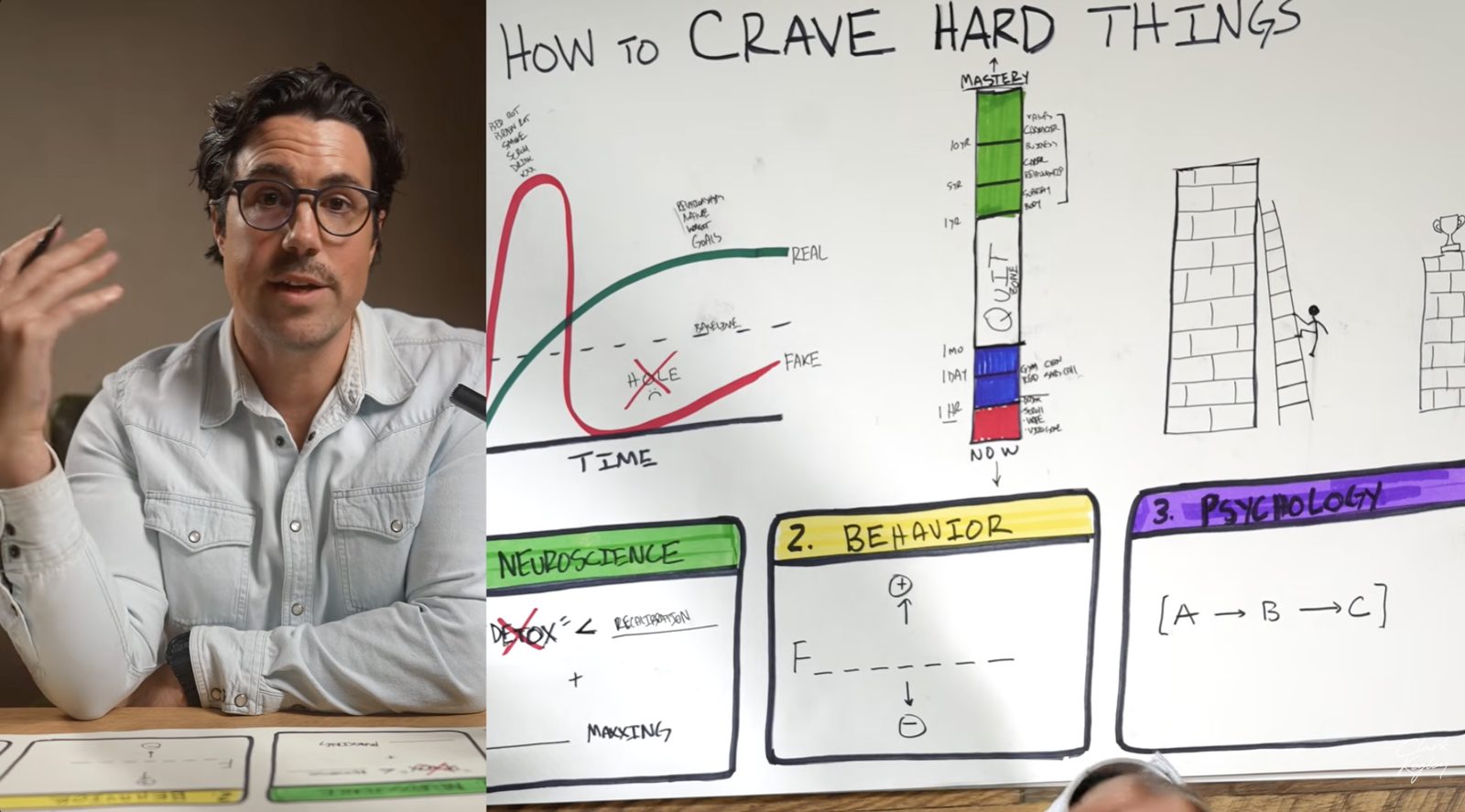
Clark breaks down why most people can’t do hard things into 3 factors:
1. Neuroscience
The main character here is dopamine.
Dopamine is a neurotransmitter released in response to pleasurable experiences. But if we choose to consume dopamine quickly — like scrolling a feed — it spikes fast and crashes just as fast.
It drops below what should be your baseline, leaving you feeling unmotivated and burned out all over again.
This is the opposite of naturally earned dopamine, which tends to build up steadily over time.
2. Behavior
Being able to consistently do something for a long enough time to actually see results — Clark calls this the “Reward-Effect Timeline.”
Most people can stick with a goal consistently for about 1 month.
Past that 1-month mark, there’s a tendency to give up before seeing results at the 1-year mark — this stretch is what he calls the “Quit Zone.”
If you manage to keep going past 1 year, all the way to 5 or 10 years, you’ve reached the “Mastery” stage.
But there’s another trap that keeps a lot of people stuck in place: clinging too tightly to the original goal.
3. Misaligned Goal
“If you’re chasing the wrong goal, no matter how hard you try, it’s still the wrong goal.” This applies to careers, relationships — even if you stick with something for 10 straight years, you’ll never reach the end goal if it isn’t aligned with what you truly want.
So how do we fix these 3 things?
Dopamine: Instead of a full dopamine detox, try dopamine recalibration.
Don’t cut it off cold turkey — limit it instead. Delete the app you’re most addicted to scrolling, set screen time limits, or declare a “No Screen Sunday” (ever notice how social media activity is lower on Sundays than any other day?).
Behavior: To keep doing something consistently, you have to start as easy as possible.
Reduce friction for what you want to do, and increase friction for what you want to avoid.
For example, if you want to go running: reduce friction by (1) laying your socks right next to your running shoes, and (2) just getting out of the room fast — you’ll figure out the rest once you’re moving.
Want to cut down on streaming time? Increase friction by canceling the subscription or deleting the card on file for auto-renewal.
Misaligned Goal: Ask yourself — is this a goal I actually want, or just an idea I picked up from society?
Use the “3 Whys” — ask yourself the question three times.
For example: “I want to quit my job soon and start a business.”
Why do I want to quit my job and start a business? → So I can make a lot of money and not have to work a 9-to-5 in an office.
Why do I want a lot of money and no office job? → So I can spend the money traveling.
Why do I want to spend money traveling? → To explore the world and gain new experiences.
Now — if I don’t quit my job, can I still explore the world and gain new experiences?
There might be other ways to get there. For example: taking on freelance clients alongside a full-time job, or finding a 100% remote job — without taking on the risk of starting a business — and still getting to travel just the same.
See? What you actually want might not be your first stated goal at all.
I think we should work on all three of these at the same time.
Keep questioning yourself until you’re confident about what you really want, and find your North Star (your internal goal).
Try to reduce and cut back on cheap dopamine.
Lower the friction on activities that move you closer to your North Star.
Maintain that pace consistently — keep going for 1 year, 2 years — until the hard thing finally starts to show results.
Reflect from Youtube https://youtu.be/ijCrXHI1g2k?si=7z5N4eUI_OQxneg7